

Tesla Model Y vs Honda CR-V: 5-Year Cost of Ownership Compared (2026)
If you are cross-shopping the best-selling EV in America against the best-selling compact SUV, the honest answer is not the one most EV coverage gives you. Over five years, a 2026 Honda CR-V is likely to cost you less to own than a 2026 Tesla Model Y — and Tesla’s own data agrees. Here is the verified, source-by-source breakdown.
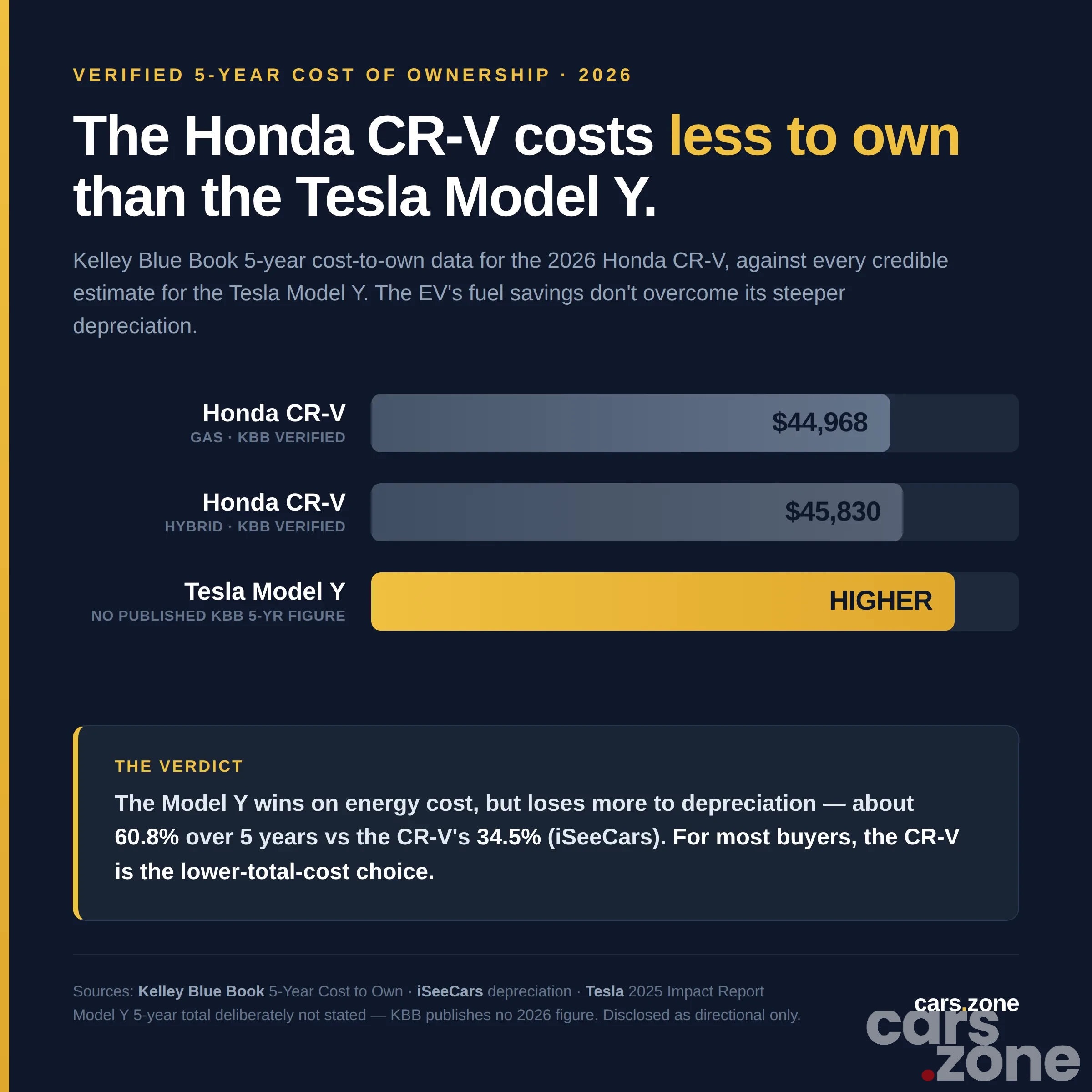
A 2026 Honda CR-V has a Kelley Blue Book–verified 5-year cost to own of $58,161. The Tesla Model Y’s 5-year cost cannot be pinned to a single trustworthy figure (KBB declines to publish one for 2026), but every credible source places it higher — driven by steep depreciation and high insurance that overwhelm the EV’s real savings on fuel and maintenance. Its far steeper depreciation — 60.8% over five years versus the CR-V’s 28.9% (iSeeCars) — together with higher insurance is what pushes its true cost above a comparable CR-V. The EV is not the automatic money-saver.
The 5-year cost of ownership, side by side
The table below uses Kelley Blue Book’s 5-Year Cost to Own data for the two Honda variants (verified against KBB’s live 2026 figures), and a disclosed range for the Model Y because no single authoritative 5-year total exists for it. Every figure is sourced; nothing is estimated to fill a gap.
| 5-year cost | Tesla Model Y | Honda CR-V (gas) | Honda CR-V Hybrid |
|---|---|---|---|
| Starting MSRP | $39,990–$45,990* | $32,370 | $37,080 |
| Depreciation | ~60.8% of value* | $15,044 | $17,548 |
| Fuel / charging | lowest | $11,524 | $8,863 |
| Maintenance | lowest | $6,347 | $5,409 |
| Insurance | highest in class | $14,120 | $14,475 |
| 5-year cost to own | no clean figure** | $58,161 | $58,830 |
Is a Tesla Model Y cheaper to own than a Honda CR-V?
No — not within five years, by the most credible evidence available. The Model Y wins on the running costs everyone expects an EV to win: it is the cheapest of the three to fuel and among the cheapest to maintain. But those savings are smaller than the EV narrative suggests, and they are overwhelmed by two costs that run the other way: depreciation and insurance.
The independent evidence is consistent: analyses from Autoblog, Recharged and iSeeCars all find the Model Y’s all-in cost lands at or above a comparable Honda CR-V once its steep depreciation and higher insurance are counted — the EV’s fuel and maintenance savings do not fully offset them.
Model Y vs CR-V depreciation: the figure that decides it
Depreciation is the largest and most decisive cost difference. According to iSeeCars, which bases its figures on actual transaction data, the Honda CR-V loses about 28.9% of its value over five years[iSeeCars], while the Tesla Model Y loses about 60.8%[iSeeCars]. On a vehicle in the mid-$40,000s, that gap is worth many thousands of dollars — more than enough to erase the EV’s fuel and maintenance savings.
Why we show the Model Y as a range, not a single number: The Model Y’s five-year depreciation is genuinely uncertain. Across credible sources the figure spans roughly 45% to 61%, because Tesla’s repeated, unannounced price cuts in 2022–2024 reset the used market overnight; by early 2026 values appear to be stabilizing. Kelley Blue Book declines to publish a 2026 Model Y 5-year cost to own at all — not an oversight, but an acknowledgment that the number is not stable enough to state. We disclose that range rather than invent a precise figure. A number whose reasoning you can trust is worth more than a precise-looking one that is quietly wrong.
Does an EV actually save money versus a hybrid SUV?
This is the comparison that matters most for a cost-focused buyer, and it is closer than the gas-versus-electric framing implies. The CR-V Hybrid already returns about 37 mpg, so the Model Y’s energy advantage over it is far smaller than over the gas CR-V. And the totals nearly converge: the gas CR-V costs $58,161 over five years; the hybrid costs $58,830 — just about $669 more, despite a higher sticker price, because the hybrid recovers most of that premium in lower fuel and maintenance. Against either Honda, the Model Y’s case rests on depreciation stabilizing and on the buyer driving enough miles, on cheap home electricity, to convert its energy edge into real money.
What the Model Y costs to charge versus what the CR-V costs in gas
This is where Cars.Zone’s own verified energy data does the work, rather than a manufacturer’s bundled estimate. At the national-average regular gas price of $3.15 per gallon (AAA Your Driving Costs 2025) and the national-average residential electricity rate of 18.83¢ per kWh (EIA Electric Power Monthly, Table 5.6.A, April 2026), driving 12,000 miles a year costs roughly:
- Tesla Model Y: about $646/year to charge at home (at 3.5 miles per kWh)
- Honda CR-V Hybrid: about $1,022/year in gas (37 mpg)
- Honda CR-V (gas): about $1,260/year in gas (30 mpg)
So the Model Y saves roughly $615 a year versus the gas CR-V and $376 a year versus the hybrid on energy alone — real money, but over five years (about $3,074 and $1,882 respectively) still short of the depreciation gap. Your own rate matters enormously, which is why the calculator below uses live figures you can adjust to your state and mileage.
Estimate your own 5-year energy cost
Adjust the inputs to your situation. Fuel and charging math uses Cars.Zone’s verified national-average energy data (AAA weekly gas; EIA residential electricity); you can override both with your local rates.
Who should buy which
Choose the Honda CR-V (gas or hybrid) if you want the lower-risk, lower-total-cost choice over five years, if you drive average miles, or if you cannot charge cheaply at home. The hybrid is the value sweet spot: near-gas total cost, with the lowest fuel bill of the two Hondas.
Consider the Tesla Model Y if you drive well above average miles, can charge at home on a low or time-of-use electricity rate, plan to hold the car long enough to ride out its steep early depreciation, and value its technology and performance. Under those conditions its energy advantage compounds enough to close the gap — but it remains a bet on depreciation, not a guaranteed saving.
Frequently asked questions
Sources & methodology
Honda CR-V and CR-V Hybrid 5-year cost-to-own figures verified against Kelley Blue Book (Cox Automotive) live 2026 cost-to-own pages, June 2026. Depreciation comparison from iSeeCars (transaction-based). Energy costs computed from Cars.Zone verified national-average data: AAA weekly regular gasoline (national average) and U.S. Energy Information Administration residential electricity rate, at 12,000 miles per year, 3.5 mi/kWh (EPA average BEV), and EPA-combined 30 mpg (CR-V gas) / 37 mpg (CR-V hybrid). These are estimates; your local rates and driving will differ. Model Y pricing from manufacturer configurator reporting, June 2026, and is subject to frequent change. Where a single authoritative figure does not exist (Model Y 5-year total and depreciation), we disclose the range and its cause rather than state a point estimate. Full methodology at cars.zone/methodology.

About the Author — Ashvin J. Sonani
Founder & Lead Researcher at Cars.Zone. Digital marketer, data analyst, and domain investor with 28+ years of internet experience, specializing in US automotive cost intelligence and source-verified data analysis. Every figure on this page is verified against its primary source and dated; see our editorial policy and methodology.